
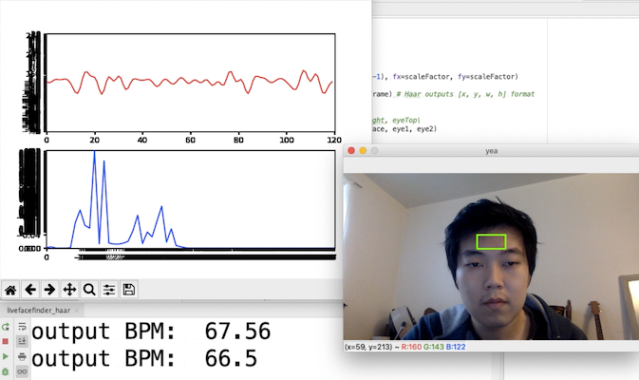
Within the framework developed for recording human data to generate to sideload, a webcam application was programmed to accurately detect the pulse in real time.
The reason for capturing this biometric data is to be able to store it and compare it with other input data that can be used to make deductions about the essence of a person and to be able to improve its computational reconstruction.
For example, how their heart reacts to music, images, messages or certain situations. Allowing the logical correlation to be established in its most probable context and to be appropriately simulated by the computer model. This would allow giving the program reactive processes and bodily sensations to stimuli, in short: to feel things.
A Gemini-generated explanation of the source article explaining this algorithm: ## Article summary: Heart rate detection using a camera
The article discusses heart rate detection using a camera. The challenges of detecting heart rate with the naked eye are discussed. A solution using Eulerian Video Magnification (EVM) is proposed. This technique amplifies subtle changes in the video, allowing heart rate variations to be seen in colour. The authors describe the process in detail, including the use of spatial and temporal filtering. They also discuss the implementation and possible applications of this technology.
Key points:** Key points:** Key points:** Key points
* Heart rate detection with the naked eye is challenging due to the subtle colour changes involved.
* EVM can be used to amplify these colour changes, making heart rate detection easier.
* The authors propose a method for heart rate detection using EVM that includes spatial and temporal filtering.
* This technology has the potential to be used in a variety of applications, such as healthcare and wellness.
Fuente: https://medium.com/intel-software-innovators/heartrate-detection-using-camera-d34b3289e272
repository hosting the application: https://github.com/marcobaturan/HeartRateCam


No comments:
Post a Comment